Wednesday, January 20, 2016

American Women In WWII

American Women In WWII
Until December 7, 1941 the day the Japanese bombed Pearl Harbor, the United States were isolationist who didn't believe in getting involved in World War II. Pearl Harbor completely changed this mindset, finally giving Franklin Roosevelt his declaration of war on Germany he had been wanting for years. Now with the onset of war the United States had to catch up if they wanted to help the Allies win the war. They were behind in all military aspects, especially building an army. With most of the men enlisting and joining the Armed Forces, the National Service Act #2 in December 1941, made the 'conscription' of women legal. At first only single women ages 20 through 30 were called up, but with war roaring by mid-1943 almost 90% of single women and 80% of married women were employed in essential work for the war effort globally.
With war waging fathers went to join the Armed Forces or were sent away to do "vital civilian work", forcing mothers to run the home alone and "get used to going out to work".  From 1940-1945 the female percentage of the United States workforce increased from 27-37 percent, and by 1945 about 25% of married women worked outside the home. During World War II more than 6 million women took up jobs outside the home, "Though women who entered the workforce during WWII were crucial to the war effort, their pay continued to lag far behind their male counterparts: Female workers rarely earned more than 50% of male wages." Women worked just as hard as the men in the workforce and many of them were single mothers as well, with their husbands in the army. Because of this women came to know flexible working hours, nurseries, and other arrangements to accommodate to the needs of working mothers.
Women made up roughly 1/3 of the total workforce in the metal and chemical industries, as well as in the ship-building and vehicle manufactories. "Rosie the Riveter" was the star for the governments campaign to recruit women workers for the munitions industry. 350,000 women joined the Armed Services, and in May 1942 Congress instituted the Women's Auxiliary Army Corps, later being upgraded to the Women's Army Corps who gained full military status. WACs worked in 200 non-combat jobs, and by 1945 there were over 100,000 WACs and over 6000 female officers. But above all of the military divisions, the aviation industry saw the greatest increase in female workers. More than 310,000 women worked in the United States aircraft industry, and in 1943 65% of the industry's total workforce were women. Women's Airforce Service Pilots, or WASPs, were the first women to fly American military aircraft and there were over 1000 of them.
Besides women assimilating into the workforce another major change for women during WWII was their fashion. Women's fashion was changed by the style of the military outfits, influencing women to often wear trousers or one-piece siren suits. Besides the influence the military attire had on the women, headgear also became more popular because it was practical for women in the workforce to keep their hair out of their way while they were working. Another fashion statement that changed because of the war were accessories, women adopted large handbags to carry all their family's different ration books, the rationing system being something the United States government developed to alleviate the pressure of the inflation happening in the country. Women also adopted the "Victory Roll" a hairstyle in which they rolled their hair up very tightly, fixed it in place, then topped it off with a swept-up curl.


Thursday, January 14, 2016

The Berlin Wall

The Berlin Wall
September 2, 1945 became the day known to the world as the end of World War II, and soon after this ending Germany was divided into four Allied occupation zones, though there were many problems with the Allies as a group. The Soviets didn't trust any of the countries in the West and the West didn't trust the Soviets causing a lot of tension. In 1948 tensions grew even deeper when the US, Britain, and France moved to unite their three occupied zones into one, and in response the USSR launched a land block of West Berlin in an effort to force the Western Allies to abandon the city completely, most of it being part of the Soviet occupation zone. To many East Germans, Western Germany was a gateway to the democratic West so many of them so desperately wanted to be a part of. 
In Winston Churchill's "Iron Curtain Speech" he states, "an Iron Curtain is falling over Europe. The Iron Curtain, the political, military, and ideological barrier erected by the Soviet Union to sell off itself and its dependent eastern and central European allies form open contact with the West and other noncommunist areas." The Iron Curtain created by Josef Stalin blocked off entry to the allied-occupied West Berlin from the East Germans. Though the United States and Britain responded with an 11-month airlift of supplies and food many East Germans were trapped there until Germany was formally reunited in 1990. 
To further officialize the Iron Curtain the Soviets had created they built the Berlin Wall, which was the barrier that surrounded West Berlin and prevented access to it from East Berlin and adjacent areas of East Germany built in 1961 and finally demolished in 1989. The building of just some barbed wire and concrete the Berlin Wall officially began its terrorizing on August 12, 1961 when a decree passed by the East German Volkskammer was passed. East Germans were forbidden to pass the Berlin Wall, "The wall would protect their [East German[ citizens from the pernicious influence of decadent capitalist culture" stated the Soviets.
On November 9, 1989 East German border guards opened the borders of East Germany, allowing Germans to freely roam their country. "Jubilant Berliners climbed on top of the Berlin Wall, painted graffiti on it, and removed fragments as souvenirs." The taking down of the Berlin Wall was a great step in history because it put Germany on the pathway back to being formally reunited as a nation, and in 1990 East and West Germany were finally brought together once again. 


Mr. Stewart

Stalin And the End of WWII

Josef Stalin was the leader of the USSR from 1929-1953, seizing power after the death of Vladimir Lenin. Under Stalin the Soviet Union was transformed from a peasant society into an communist, industrial, military, super power. Though the USSR was great in many ways especially in their military strength, Stalin killed what historians estimate 20 million people while he was in power.
August 23, 1939 Hitler and Stalin surprised the world by signing the Nazi-Soviet non-aggression pact, which divided their influence and territory within Eastern Europe resulting in the invasion of Poland in September 1939 ultimately starting World War II. Though these two great nations were allied, Germany later violated that agreement in June 1941 when he invaded the Soviet Union. The USSR was surprised and appalled by the German attack therefore needing to turn to the Allies in the West to look for help. Because of their desperation the Soviet Union allied with Britain and the United States in 1941, becoming known to history as one of the most successful alliances in military history but one of the most uneasy ones as well. The Soviet’s were communists, the Western Allies were capitalists, and capitalists did not get along well with communists.
Without the help of the United States and Britain, Stalin and the Russians beat the Germans in two major battles, that became turning points for the entire war. The first was the German defeat at Stalingrad which was the first real German offensive loss, which resulted in about 300000 German soldiers killed. And the other was the Battle at Kursk was the last German offensive battle on the Eastern Front. These two battles ultimately kicking Germany out of Russia scared the Western Allies, what were they to do if the Russians beat the Germans and instilled peace in Europe before they even got there? Russia would be too powerful and build a mask of communist influence around all of Europe.
World War II ended September 2, 1945 but the fighting in Europe was long but over. The physical battles may have been done and the German empire might have died off but there was a new American British and France enemy, the Soviets. Because of this tension the beginning of the Cold War was under way, 1946-1989. It all started when the USSR started to establish communist governments throughout Eastern Europe and in 1949 the Soviet nuclear age started by exploding their first atomic bomb. They became the second country in the world to successfully develop a nuclear weapon as well as launch the Great Plan for Transformation Nature in response to widespread famine and the Great Construction Projects of Communism. A new ally the USSR had made was communist regime, North Korea, whom they helped in 1950 by giving the leader permission to invade the United States-supported South Korea, triggering the Korean War.


Mr. Stewart

Tuesday, January 12, 2016

Pearl Harbor

Pearl Harbor
September 1, 1939 Adolf Hitler invaded Poland, September 3, 1939 Britain and France declare war on Germany, starting WWII. For two years America had been involving themselves with the allies, there had been 2 years of fighting but America was helping in their own way, with their short-of-war strategy. This strategy was basically America helping out their allies in every way except actual fighting, they did this because most Americans were isolationist and Roosevelt didn’t have enough power to fight against the Neutrality Laws, especially because at the time he was attempting to get re-elected in the 1940 election, and to do so he had to portray himself as pro-isolationism even though he knew America would eventually have to get involved in the fighting happening in WWII. 
December 7, 1941, the Japanese attack Pearl Harbor, Hawaii. Japanese fighter planes attacked for roughly two hours, leaving damage but damage that could be repaired. The United States was on its heels in the Japanese sense and this attack was a huge surprise to the citizens. The Japanese wanted Pearl Harbor to destroy the aircraft carriers, the queens of the chessboard during WWII, but lucky enough for the United States the aircraft carriers were not at Pearl Harbor. The only thing the Japanese did destroy that could not be repaired for the Americans was the USS Arizona, a battle ship that was bombed at 8:10 A.M with an 1800 pound bomb. The ship exploded and immediately sank trapping roughly 1000 men inside. The Japanese wanted to destroy the the Pacific Fleet, but unfortunately for them they just poked the bear, not killed the bear. “After the Pearl Harbor attack, and for the first time after years of discussion and debate, the American people were united in their determination to go to war…On December 8, Congress approved Roosevelt’s declaration of war.” (history.com)
 One part of Pearl Harbor that did work for the Japanese though was the fact that it was only a small part in a huge Japanese military operation to take over the Dutch East Indies because of their loss of their oil supply, the United States. At the same time the Japanese attacked Pearl Harbor they attacked Burma, Singapore, and the Dutch East Indies. The Japanese plan was to hit America and the European powers as hard as they possibly could (the islands listed above European holdings) and then form a line of defense. 


Mr. Stewart

Monday, January 11, 2016

The 442nd- "Go for Broke"

The story of America's most decorated military unit in American history, the Japanese 442nd Regimental Combat Team.
You fought for the free nations of the world along with the rest of us...You fought not only the enemy, but you fought prejudice--and you have won..."- President Harry Truman, 1946


Who Were They?
The 442nd Regimental Combat Team was the amalgamation of two units, the 100th Infantry Battalion comprised primarily of Hawaiian National Guardsmen and the 442nd Regimental Combat Team. The original 442nd RCT was comprised of Japanese men who volunteered from their internment camps, were living outside of the West Coast Exclusion Zone (the three states that border the Pacific) , or who were already serving in the military before war broke out. Just like other ethnically segregated units, a good example being the 92nd "Buffalo Soldiers" Infantry Division, the soldiers were Japanese but the officers were all white.

What They Did
The 442nd RCT served in Europe, for the leaders in Washington were both thoughtful enough to not have them serve in the Pacific theater against the Imperial Japanese Army. Though certain units were sent to the Pacific theater where they encountered old friends, friendly fire, and heavy racial discrimination.
I believe the propaganda value of such a step would be great and I believe they would make good troops. We need not use them against members of their own race, but we could use them for many useful purposes- Secretary of War Stimson 1942
The call was put up for 4500 Japanese males to enlist and while response was muted among the interned on the mainland, nearly 10,000 Hawaiians of Japanese descent enlisted to serve. The Hawaiians did not understand the animosity from the interned Japanese volunteers but they blended together into one unit.
"All of us can't stay in the [internment] camps until the end of the war.  Some of us have to go to the front.  Our record on the battlefield will determine when you will return and how you will be treated.  I don't know if I'll make it back."- Sgt Abraham Ohama (KIA 1944)
Victorious 442nd soldiers with a captured enemy flag.The 442nd entered Italy in 1943 in the Naples-Foggia Campaign and served in Northern Italy, the Alps, Southern France, and the Rhineland. They fought valiantly at Monte Cassino and took enough casualties to be nicknamed the Purple Heart Battalion. The 442nd fought as the American line advanced north in Italy and were transferred over to Northern France. There they liberated Bruyères and Biffontaine before being sent on their most famous mission, the rescue of the Lost Battalion.


In late 1944, the 1st Battalion, a largely Texan infantry unit, overextended and was enveloped by the German line. The Texans received limited help from air drops but were trapped in a chokehold by advancing German troops. For six days, under constant artillery and machine gun fire, the 442nd pushed forward towards the encircled "Lost Battalion". Outnumbered 4 to 1 in some sectors, the Japanese-Americans eventually breached the German line and saved the 211 trapped Texans at a much higher cost to their own. "Suicide Hill" witnessed a brutal bayonet charge by the 442nd and at the end of the battle, Companies I and K emerged each with 15 men from the 100 they started with. The sergeants were in charge because all higher ranking officers had been killed or wounded. Though many complained they were being used as cannon fodder, the Japanese nevertheless proved their worth in that one engagement.


"The Nisei troops are among the best in the United States Army and the respect and the appreciation due honorable, loyal, and courageous soldiers should be their's rather than the scorn and ridicule they have been receiving from some thoughtless and uninformed citizens and veterans."- Major General E.M. Almond
  

Their Honors
The unit's 14,000 men who served the course of the war were awarded 18,143 individual decorations; these included 52 Distinguished Service Crosses, one Distinguished Service Medal, 560 Silver Stars, 22 Legions of Merit, 4,000 Bronze Stars, 12 Croix de Guerre, and 9,486 Purple Hearts. The unit also earned 21 Medals of Honor and 8 unit citations, an unprecedented amount for a unit that size.

Discrimination
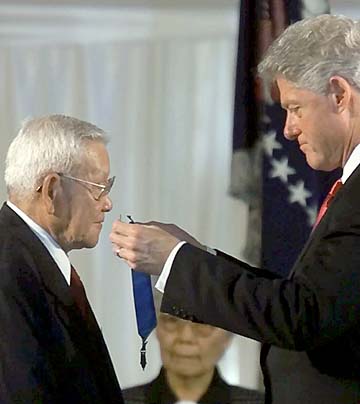
Despite their outstanding action in combat and undeniable sacrifices, of the 464 Medal of Honors awarded, only 2 went to Asian-Americans, only one of those went towards a member of the Japanese-American units (the other was a Filipino scout). In 2000, after a 1996 study commission of racial bias in WW2 was released and after over 50 years of not receiving their proper recognition for heroism, President Bill Clinton upgraded 22 awards to the Medal of Honor making the 442nd the most decorated unit for its size in American history.


"Rarely has a nation been so well served by a people it has so ill-treated. They risked their lives, above and beyond the call of duty. And in so doing, they did more than defend America; in the fact of painful prejudice, they helped to define America at its best."- President Bill Clinton, 2000


Works Cited
"100th Infantry Battalion and 442nd Regimental Combat Team (RCT)." Japanese American Museum of San Jose. JAMsj, n.d. Web. 11 Jan. 2016.

"442nd Regimental Combat Team Activated - Hawaii History - Short Stories." 442nd Regimental Combat Team Activated. Hukilau Network, n.d. Web. 11 Jan. 2016.


"442nd REGIMENTAL COMBAT TEAM." 442nd Regimental Combat Team Facts. The 442nd Regimental Combat Team Historical Society, n.d. Web. 11 Jan. 2016.

"442nd REGIMENTAL COMBAT TEAM." 442nd Regimental Combat Team Historical Society. The 442nd Regimental Combat Team Historical Society, n.d. Web. 11 Jan. 2016.

"442nd REGIMENTAL COMBAT TEAM." Go For Broke. Go For Broke National Education Center, n.d. Web. 11 Jan. 2016.

Grubb, Abbie Salyers. "Rescue of the Lost Battalion." Densho Encyclopedia. Densho, n.d. Web. 11 Jan. 2016.

Hull, Michael D. "Japanese-American 442nd Regimental Combat Team - July '96 World War II Feature." History Net: Where History Comes Alive. History Net, 19 Aug. 1996. Web. 11 Jan. 2016.

"Japanese American Service in World War II." Wikipedia. Wikimedia Foundation, n.d. Web. 11 Jan. 2016.

Kakesako, Gregg K. "Medal Winners Honored at the Pentagon and on Floor of the U.S. Senate." Honolulu Star. Honolulu Star-Bulletin, 22 June 2000. Web. 11 Jan. 2016.

"List of Asian American Medal of Honor Recipients." Wikipedia. Wikimedia Foundation, n.d. Web. 11 Jan. 2016.

Map of Japanese American Internment Camps. Digital image. Wikipedia. Wikipedia, n.d. Web. 11 Jan. 2016.

Niiya, Brian. "Congressional Medal of Honor Recipients." Densho Encyclopedia. Densho, n.d. Web. 11 Jan. 2016.

Tsukiyama, Ted. "442nd Regimental Combat Team." 100th Infantry Battalion Veterans. 100th Infantry Battalion Veterans, n.d. Web. 11 Jan. 2016.

Friday, January 8, 2016

The Arsenal of Democracy and the Four Freedoms

Arsenal of Democracy was a slogan used President Franklin Roosevelt in a radio broadcast December 29, during the time of World War II. During this speech Roosevelt promised Lend-Lease to the British, bringing up the idea for the first time. The Lend-Lease bill was passed in Congress on March 11, 1941. The Arsenal of Democracy that Roosevelt referred to as the United States didn’t represent just one city but the country’s industries as a whole and their support of the Allies. 
The origin of the phrase and that America was an arsenal came from the playwright by Robert Sherwood, the quote saying “this country [The United States] is already, in effect, an arsenal for the democratic Allies”. Roosevelt first used this phrase to stress that the American people not the American government had the power to turn the tide of the war. Roosevelt said “We must be the great arsenal of democracy. For us this is an emergency as serious as war itself” The meaning of the speech and the phrase “the arsenal of democracy” marked the decline of the isolationist and non-interventionist doctrine that had dominated the interwar US foreign policy, it marked the approach to entry into WWII. Though many Americans didn’t know it at the time the German’s knew it, after President Roosevelt announced that the United States was meant to be “the arsenal of democracy” German production increased, knowing that the United States were soon to enter into the war. 
Soon after the Arsenal of Democracy Speech was given President Roosevelt gave the Four Freedoms as the United States goals in his Four Freedoms Speech on January 6, 1941. The Four Freedoms according to President Roosevelt were, freedom of speech, freedom of worship, freedom from want, and freedom from fear.
Freedom of speech was meant to be everywhere in the world, following back to Roosevelt’s idea of the United States being “the arsenal of democracy”. The United States acted as the police of the world and the keepers of peace. The next freedom, the freedom of worship was that every person, throughout the world could worship the God they believed in, in their own way. The third freedom, the freedom of want, meant in world terms that economic understandings will secure every nation a healthy peacetime life for its inhabitants. And the final freedom, the freedom from fear, meant that a world-wide reduction of armaments to a point and in a thorough way will put no nation in any position to commit an act o physical aggression on another. 
This speech was “largely about the national security of the United States and the threat to other democracies from world war that was being waged across the continents in the eastern hemisphere” Another purpose of the Four Freedoms Speech was to provide national rational for why the United States could no longer be pro-isolationism, and that they must soon get involved in World War II, not necessarily through fighting but definitely through the soon to be passed Lend-Lease Bill. 
The Four Freedoms inspired many Americans and helped them to realize that they indeed needed to be involved in the war in order for Germany not to become the major superpower of the world. Up until this point the United States citizens didn’t understand how dangerous the Nazi German empire was, but this speech and the soon bombing of United States ships by German U-Boats helped the Americans realize that they must be involved. “The declaration of the Four Freedoms as a justification fro war would resonate through the remainder of the war, and for decades longer as a frame of remembrance. The Freedoms became the staple of America’s war aims, and the center of all attempts to rally public support for war.”


Wednesday, January 6, 2016

The Munich Crisis and the Beginning of World War II

The Munich Agreement was an agreement signed September 30, 1938, widely known today as “a failed act of appeasement towards Germany”. The agreement was discussed and negotiated at the Munich conference among the Great Powers of Europe, excluding the Soviet Union and Czechoslovakia. The agreements was signed by Germany, France, the United Kingdom, and Italy. The main purpose oft he conference was to discuss the future of the Sudetenland, a territory on Czechoslovakia’s borders, because Germany had just invaded it. The invasion of the Sudetenland came directly after the German absorption and overtaking of Austria in March 1938. The invasion was such a big deal to Czechoslovakia because most of its border defense were held and stationed there, also enstated there were many of its banks and heavy industries. Prior to the invasion Hitler made many speeches on why he was going to invade, those being that over three million of the residents of the Sudetenland were of German background and because of that background they needed to return and be reunited with their homeland. Hitler was benevolant and refused to avoid war, he wanted the Sudentenland and the “superior" race to rule the world. So the Munich Conference and agreement were held as a last minute device to save the continent from war, eventually though war still did happen with Hitler’s invasion of Poland. 
After Neville Chamberlain, who represented Great Britain, returned home from the Munich Conference he gave a speech to his people stating, “The Munich Pact [was] bringing ‘peace with honor’ and ‘peace in our time’” Though many disagreed with him, including the famous Winston Churchill who argued that, “the Munich Agreement became a byword for the futility of appeasing expansionist totalitarian states, although it did buy time for the Allies to increase their military preparedness”. Though many British citizens especially Chamberlain believed that peace was among them they were wrong, “In March 1939, Hitler annexed the rest of Czechoslovakia, and the country ceased to exist” 
Long awaited, “September 1, 1939 German army divisions invaded Poland despite British and French threats to intervene on the nation’s behalf. Two days later, Chamberlain solemnly called for a British declaration of war against Germany, and World War II began."