Sunday, May 8, 2016

George Kennan

George Kennan


George Frost Kennan was arguably one of the most influential policy makers in American history. As a graduate of Princeton University, Kennan spent most of his life a voracious learner, developing an interest in Soviet affairs from his time spent at the University of Berlin. He then became a third secretary and eventually a part of the United States embassy in the Soviet Empire. This history with and intense study of Soviet affairs led Kennan to be better qualified than most in the way to go about creating policy with the Soviets. Even so, Americans were hesitant to listen to what he had to say.
His policy was simple; the idea of containment. He believed that any further negotiations with the Soviets were futile and that America needed to halt diplomatic relations with the country. Rather than trying to appease Soviet powers, he believed that the creation of spheres of influence should be made, so that America could stop communism from seeping into other countries that could then rise up against them and the rest of the world. As this was one of Marxist, leninist, and Stalinist goals, this idea was developed from solid ground. Overall, Kennan wanted to contain communism and stop it from spreading by either force or ideological draw. While Kennan may not have realised what he was asking for with his idea for a sphere of influence, his policy could arguably be the reason behind the cold war.
When dissecting the influence of the policy of containment, it is important to understand that it was the background for the Cold War, the Vietnam War, and the Korean War. In the Cold war, the development of a sphere of influence and a halt to diplomatic relations led to two hostile spheres, one communist and the other “democratic”. These spheres were developed through both the ideological influence that either side had over a specific region, such as the ties between many European countries and the United States, as well as through forceful backing of new political parties, such as the American backing of a coup in Guatemala. However, as discussed in many historical documentations as well as in our own AP US history class, these coups rarely worked out well. As a matter of fact, these coups never worked out well. Two very important examples would be the US “aid” which led to full out war in both Korea and in Vietnam. In Korea, the United States were fearful of the communist North invading South Korea. They sent troops to help the South defend itself, and then under General Douglas MAcArthur, they tried to invade the North to unify Korea under the American democratic influence. However, the North, backed by China, retaliated and eventually forced the US to withdraw troops. A very similar occurrence plagued the US foreign appearance, but in Vietnam the Vietcong were the ones to force an end to US occupation. Overall, it is clear to see that Kennan’s influence in the West was incredibly powerful.

Mao Zedong

Born on December 1893 to a peasant family in central China, Mao Zedong grew up in an environment where education was valued as training for records and accounts, not for the purpose of knowledge. As a young man, Mao was unsure of his career and drifted around from police school to law school to business school. Among these many fields of study, Mao also trained as a teacher and travelled to Beijing where he worked in the Peking University library. This is where his communist career began because in the library he began to read marxist literature. Moved by communist ideals, Mao became a member of the Chinese Communist Party(CCP) in 1921.

During the interwar period, China was in a state of turmoil. In 1927, the Kuomintang nationalist party, led by Chiang Kai-shek, launched an anti-communist purge. During the war with Japan, these two parties were allied with each other but when the war ended, a civil war broke out between the two parties. The Communists ended up winning the civil war and in October 1949, the People’s Republic China(PRC) was set up with Mao as its leader. As a result of becoming Communist, Chinese industry was owned by the state and farmers were organized into collectives. In 1958, in an attempt to industrialize China, Mao launched the Great Leap Forward. This program included the mass mobilization of labor to improve agricultural and industrial production. However, the Great Leap Forward flopped and there was a massive decline in agricultural output, with poor harvests that led to famine and the deaths of millions. With tension growing in the nation, Mao launched the Cultural Revolution in 1966, trying to re-assert his authority. The Cultural Revolution was designed to purge the country of “impure elements” and revive revolutionary spirit. It was also an excuse for Mao to get rid of rebellious leadership that had defied him in the previous years. As a result of the Cultural Revolution, people began to lose confidence in Mao so he sent in the army to restore order, which only exacerbated the situation.

Mao died on September 9, 1976. Mao’s career as China’s leader was marked by ups and downs. Many historians credit Mao with coordinating guerrilla warfare that helped win the civil war and overthrow the nationalists. Others also applaud him for re-distributing the land back to the peasants and restoring China’s independence. However, Mao’s resume was tainted by his programs the Great Leap Forward and the Cultural Revolution. Many believe they were ill-conceived and although Mao laid the foundation for the industry which contributed to the major economic development in the 20th century, he is criticized for his methods as being violent and self-defeating.

The Iroquois Confederacy

The Iroquois Confederacy


Many Americans, when recounting our colonization of the Americas, tend to be overzealous in describing the ways in which we dealt with the many native inhabitants. We describe our dealings with the “savages”, depicting these people as uncultivated and simple when compared to ourselves. However, what we fail to recognize is the fact that those who inhabited the land that we had so quickly called our own had been developing for decades. Native American society was complex and heavily cultural, and had already developed some of the thoughts that many Americans struggled with late into the 20th century. Looking at one sole manifestation of the development of the Native American society, the Iroquois Confederation hosted one of the most complex examples of democratic society since Rome, except the fact that women were thought of as more than property.
Within the Iroquois confederation, or the 6 Nations of the Iriquois, all of the primary necessities were enacted. First of all, the confederacy was a grouping of tribes that had come together in order to maintain protection against the other warring tribes. They were maintained as protection against other stronger tribes.  There was a groups of leaders of each tribe that formed the “League of Clan Leaders”, which was interestingly enough a voting group where each clan was represented by a number of chiefs proportionate to their village’s population. Moreover, while this may have seemed to overpower certain tribes in meetings, this bias was ruled out due to the fact that decisions were reached through popular consensus rather than majority vote. Doesn’t this ring a bell? Probably because the House of Representatives of the United States, while not proven, may have been modelled off of this very manifestation of democratic governing.
Moving on to the cabinet/senate (in American Terms), these two entities were combined under those who were granted sachemship and became Pine Tree Chiefs, who were able to contribute to the discussion. These were also part of the League of Clan Leaders, but were chosen into their roles by the Grand Chief, who was, in fact, a woman. Within debates over important policies within the confederation, if popular consensus was not reached, the then Chieftain would have to debate over what the appropriate solution was. They even had a “Bill of Rights” where any decision made by those belonging to the confederacy’s government could not encroach on any of the holding of the tribes within the League.
This complex and functioning group of people have so often been referred to as “savages” or as uncivilized that it is important to understand the complexity of their society. They developed a society that was extremely successful in its undertakings of peace and prosperity, up until the Puritans arrived. And most importantly, it is important to understand that this Confederacy may have been the basis on which many ideas of the Constitution have been founded, especially when tracing where the Enlightenment thinkers who influenced the creation first “discovered” their ideas.

Saturday, May 7, 2016

Donald Trump

On June 14, 1926 this horrible man was born in Queens, New York, and sent to military school when he was 13, because his parents wanted him to channel his energy into something good. Later in 1968 he graduated from the Wharton school of finance with a degree in economics. After he graduated, Trump worked at his father real estate company. He convinced his dad to be more liberal in the use of loans based on equity, and financed an expansion in company holdings. In 1971 he got control of the company and named it the Trump Organization. That same year he moved to Manhattan for the economic opportunities there, and started working on large buildings, and public projects to earn public recognition. 6 years later he married Ivana Winklmayr and had 3 kids with her, yet divorced her in 1991. He married agin in 2 years later and divorced her 4 years after that. In 2005 he tried for a third time at marriage and had his 5th child with Melania Knauss. In 1982 he opened the $200 million apartment retail complex known as Trump tower, bringing him national attention. Trump was going to seek the Reform party's nomination for president in 2000 but withdrew his candidacy after a bad California primary. In 2004 he began to star in a NBC reality tv show called The Apprentice. In 2012 he announced he was considering running for the presidency again, but had his political reputation discredited when he was found to be in association with the Birther movement. This was a group that believed Obama was not born in the US. On June 16, 2015 he announced his running for president a 3rd time on the Republican ticket, and today he is the only Republican candidate. After his anti immigration and remarks about Mexicans etc, NBC cut their business ties with him. Many companies have since dropped their ties with him as well, but he tried to sue the company for $500 million claiming that his claims were distorted by media.
http://www.trump.com/biography/
http://www.biography.com/people/donald-trump-9511238#synopsis

Friday, May 6, 2016

The Green Party

On the Democratic side of the 2016 election, Hillary Clinton is basically the nominee (short of a complete reversal in California that somehow wins Sanders all of its delegates and Clinton's super delegates). Clinton is one of the most unpopular Democratic frontrunner on decades, and this is before any kind of confrontation with the Republicans. Her establishment-friendly side is attacked by Sanders' supporters who have effectively demonized Clinton with her Wall Street ties and pro-intervention voting history. As Clinton's reputation and popular appeal continues to drop with each development on the campaign trail, many Democrats and left-leaning independents are looking towards alternatives. As she gears up to face Trump in the main election, her own party has a lot of things to consider themselves.

While there seems to be some strange crossover voters from Sanders to Trump, the larger trend of Sanders' voters is not quite certain yet because the race has not ended. Regardless, striking numbers are revealing themselves with nearly a quarter of Sanders's supporters vowing to never vote for Hillary. While the battle in the Democratic Party is not as big as it is within the Republican party, shifts are occurring. There are clear generational gaps in the party and positions about trade, Wall Street, American deployment, healthcare, and education vary greatly between older Democrats who tend to support Clinton and younger ones who tend to be Sanders' supporters. With independents and Sanders' supporters lost, this is the gap for another rise in the Green Party.

The Green Party was founded in 1984 with a complete focus on equality and protection of the environment. Currently they have 36 states and Washington DC granting them ballot access and are fighting for many more. In 2000, Ralph Nader was the Green Party candidate who won 2.54% of the vote and was criticized for taking enough votes from Gore in Florida to give it to Bush. The current candidate, Jill Stein, swept her party's primaries and is moving to get more name recognition.

Their Platform

Social

The Green Party runs on its Four Pillars, or 10 Key Values. These include grassroots democracy, social justice, ecological wisdom, non-violence, decentralization, community based economics, feminism, respect for diversity, global responsibility, and sustainability. Their largest social issue is the driving force behind their movement, that is, the environment. The Green Party aims to promote ecological conservation and more earth-friendly policies. Additionally, the Green Party advocates for the handing of power down to more local and regional bodies with more democracy and less elitism from the wealthy. Their social justice value aims to use the government to fight all forms of racism, ageism, sexism, and disability barriers in employment and everyday life.

Economic

Their budget revolves around a drastic restructuring towards a more community and social oriented role. By slashing the budget of the military by 50% and raising taxes on the wealthy, the Green Party hopes to be able to diver these funds into a "Green New Deal" and paying for universal health care and freer education. This "Green New Deal" is promoted as a way to create 20 million jobs and move the United States towards completely renewable energy. The Green Party also calls for a universal income, tax incentives to companies that redistribute wealth, and attempt to cut out all loopholes for the rich in our current tax code. More funding would also go to making the internet a tax-payer utility, rebuilding infrastructure, and fully opposes any and all attempts to privatize social security.

Foreign Policy

The Green Party has a very idealistic bent towards foreign policy that would support human rights and the environment around the world. The Party vows to fight all corporate influence and maintain deals and negotiations that include strong provisions for the environment and human rights. Their largest policy change would be regarding the military. While supporting self-determination for Israelis and Palestinians while also helping social justice in lesser developed countries, the Green Party takes a few more radical stances on other issues. These include the revocation of the United States' veto power in the UN and the complete defunding of all nuclear weapons based research and maintenance while also pursing a world wide disarmament treaty.


With the 2016 election gearing up, Jill Stein and the Green Party will have a much harder time than the Libertarians in overcoming the perceived idealism of their entire platform. More specifics will have to be released in order for them to gain any traction amongst voters who still view liberal third parties as deadly to the left-leaning Democratic party. It is up to Stein to take advantage of political disunity to make the case for her party.

Works Cited
The Clinton Campaign Thinks Donald Trump Is Helping Hillary. N.d. Business Insider. By Hunter Walker. Web. 06 May 2016.
Foran, Clare. "The 'Never Clinton' Campaign." The Atlantic. Atlantic Media Company, 5 May 2016. Web. 06 May 2016.
"Four Pillars - 10 Key Values." Www.gp.org. N.p., n.d. Web. 06 May 2016.
Glum, Julia. "A Third-Party Candidate To Stop Trump? Ben Sasse Demands 'Adult' Challenger To Republican Nominee And Hillary Clinton." International Business Times. IBT Media, 05 May 2016. Web. 06 May 2016.
"Green Party on Foreign Policy." Green Party on Foreign Policy. N.p., n.d. Web. 06 May 2016.
Green Party US. N.d. Www.gp.org. Web. 06 May 2016.
"History." Www.gp.org. N.p., n.d. Web. 06 May 2016.
Holthaus, Eric. "Can the Green Party Make a Comeback in 2016? | VICE | United States." VICE. Vice Media, 9 Feb. 2015. Web. 06 May 2016.
Jill Stein's Platform More Viable than Bernie's. N.d. - American Herald Tribune. By David Swanson. Web. 06 May 2016.
"Sanders Voters Can Turn to Stein." Www.gp.org. N.p., 4 May 2016. Web. 06 May 2016.


The Libertarian Party

Recently, a certain person became the presumptive nominee of the Grand Old Party, or the Republican Party. This man is of course Donald Trump. His incendiary comments about women, Democrats, Republicans, poor people, politicians, Washington DC, the disabled, the press, Muslims, Hispanics, the Chinese, African Americans, prisoners of war, Iowans, liberals, and others have driven wedges between his own "Silent Majority" and the GOP establishment. Despite being continually attacked by all newspapers, radio shows, and television programs as well as demonized by nearly every single Republican official and almost every single Democrat, he has managed to eke out a win from what was originally 17 Republican candidates.

 
With a long list of GOP officials not backing Trump (among these are Speaker of House Paul Ryan, 2012 GOP candidate Mitt Romney, 2016 candidate Jeb Bush, 41st president George H.W. Bush, Senator from South Carolina Lindsey Graham, 2008 candidate John McCain, Senator from Nebraska Ben Sasse, Former Texas Representative Ron Paul, conservative radio host Glenn Beck, and dozens of GOP strategists and conservative pundits), many are turning to the alternatives. With Clinton as an avowed no from many conservatives, evangelicals, constitutionalists, and fiscal conservatives, these voters have arrived at the largest third party in the United States, the Libertarian Party.
 

The Libertarian Party was formed in 1971 by eight activists who wanted maximum personal freedom and limited government in all sectors. By 1980, they had ballot access to all 50 states and Washington D.C. Since the 2004 election, they have been the largest third party in the United States and won over a million votes in the 2012 election. In a hypothetical matchup of the 2016 election, Gary Johnson of the Libertarian Party currently polls around 11 percent.

Their Platform

Social

The largest emphasis of the Libertarian Party is on personal freedoms and against the idea of a larger government. They support the constitution to the letter and oppose all forms of government censorship. Their support for personal liberty is completely hands off with their advocacy of the complete legalization of drugs, gambling, and prostitution. Additionally all restrictions on marriages and gay rights ought  to be taken down. One of their largest points for 2016 is the legalization of marijuana and the complete takedown of the NSA and the end of all domestic surveillance programs that infringe on the rights of Americans. As for the War on Drugs, the Libertarian Party has largely found this to be a failed policy that has only put thousands of Americans in jail and caused unjust suffering to hundreds of thousands in Latin America.
"I want gay people to be able to protect their marijuana plants with guns." -Tim Moen, Canadian Libertarian Party 

Economics

The Libertarian Party supports the FairTax which involves the complete removal of all federal taxes such as the income tax, corporate income tax, payroll tax, capital gains tax, gift tax, and estate tax in favor of one sweeping consumption tax. Rebates would be given back for all purchases up to the poverty level with the IRS being abolished and control being largely given to the states. The party considers all controls on prices and wages as well as government seizure of land as unconstitutional and against the right to own property. Additionally proposals include removing all subsidies, moving the government out of social security planning, moving government out of education, and opening up health care to the free market.

Foreign Affairs

The third leg of the Libertarian Party is their non-interventionist, self-defense oriented foreign policy. Libertarians believe that American interventionism and militarism has led to more terrorism and instability than it has supported. They believe that the United States intelligence agencies must have more transparency and oversight in their actions. Libertarians wish to cut military spending, military aid, subsidies to US arms companies, and promote peace with the world. They also support removing all restrictions on freedom of trade and immigration (except in the cases of clear and recorded national security threat).


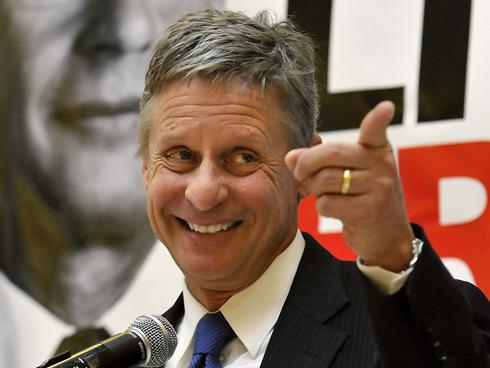
As the 2016 election draws closer, the presumptive Libertarian Nominee, former Govenor Gary Johnson (unless he is upset by Austin Petersen) will have to make a large case to Republicans who have vowed to never support Trump. If he is able to do so, the Libertarians stand a good chance of picking up many of the remains of the once proud GOP.


Works Cited
Cillizza, Chris. "Donald Trump Likes to Talk about the ‘silent Majority.’ For Many, That Has Racial Overtones." Washington Post. The Washington Post, 27 Aug. 2015. Web. 06 May 2016.
A Donald Trump Candidacy Still Doesn't Bother Me Because Things Can Always Be Much Worse | RedState. 2016. RedState. Web. 06 May 2016.
French, David. "Is the Libertarian Party's Gary Johnson a Plausible Alternative to Trump and Clinton?" National Review Online. National Review, Inc., 5 May 2015. Web. 06 May 2016.
Gary Johnson Enters 2016 Presidential Race. N.d. The Libertarian Republic. Web. 06 May 2016.
Gillespie, Nick. ""I Want Gay People to Be Able to Protect Their Marijuana Plants with Guns."" Reason.com. Reason Foundation, 5 Mar. 2014. Web. 6 May 2016.
Gorman, Michele. "These Republicans Say They Won't Vote for Donald Trump in Election." Newsweek. Newsweek LLC, 06 May 2015. Web. 06 May 2016.
Libertarian Party. N.d. Web.
Miller, Joe. "Unspinning the FairTax." FactCheckorg. Annenberg Public Policy Center, 31 May 2007. Web. 06 May 2016.
O'Reilly, William F.B. "This Year Could Be Different for Libertarian Gary Johnson." Newsday. Gordon McLeod, 1 May 2016. Web. 06 May 2016.
"Our History." Libertarian Party. N.p., n.d. Web. 06 May 2016.
"Platform." Libertarian Party. N.p., n.d. Web. 06 May 2016.
Staff, MSNBC. "Meet the Republicans Speaking out against Trump." Msnbc.com. NBC News Digital, 06 May 2016. Web. 06 May 2016.


Sunday, May 1, 2016

The Effects of 9/11


The terrorist attacks on the World Trade Center and the Pentagon on September 11, 2001, sparked a war that would dominate President George Bush’s presidency and become a recurring issue in the future.
Soon after the attacks, President Bush signed the Patriot Act and formed a new Department of Homeland Security, created in a consolidation of 22 other existing offices, in 2002. Immigration and Naturalization Service and the US Customs Service, which were both formerly a part of the Department of Justice, were consolidated into the U.S. Immigration and Customs Enforcement (ICE). The agency has caused a large increase in deportations, which have nearly doubled since 9/11. The Patriot Act, which would soon be the subject of ongoing controversy, enabled the U.S. government to collect information from citizens’ phone calls, emails, internet browsing history, and other personal details in order to identify potential terrorists. The budget of the Department of Homeland Security almost tripled in the coming years, from $16 billion in 2002 to over $43 billion in 2011. This increase in defense spending demonstrated the shift in priorities to foreign affairs and many citizens protested that the government should be allocating more money to solve domestic issues, especially when the recession of 2008 set in.
Bush also sent American troops into Afghanistan to break up terrorist groups, specifically the Taliban under Osama bin Laden. While the Taliban was disrupted, bin Laden was not captured until later. Bush also strengthened intelligence gathering services and the military in order to combat terrorism. His 2003 invasion of Iraq was controversial, and while he did succeed in capturing Saddam Hussein, the invasion and subsequent deaths of both American soldiers and Iraqi civilians cast a shadow over the operation. The invasion was based largely on Hussein’s regime allegedly having weapons of mass destruction, but none were ever found. He pledged that the U.S. would help Iraq establish a democratic government in order to gain an ally in the war on terror, but American entanglement in the conflict there became increasingly unpopular. Although the U.S. officially withdrew from Afghanistan in 2014, the military remains active there in an attempt to stop ongoing terrorism.

Sources