It was recently announced that President Obama will be visiting Hiroshima later this month. Last month, Secretary of State John Kerry became the highest ranking member of the American government. Many politicians are saying this visit should not be seen as an apology in any way to Japan for Truman's decision to drop an atomic bomb of the people of Hiroshima. Should America have to apologize for Hiroshima? The answer is overwhelmingly yes. Not only should America apologize for the bombing of Hiroshima, but the other atrocities and human rights violations it committed during World War II. The unanswered question and debate between many historians is whether or not the bombings saved more lives by ending the war. Commander in Chief Lemay believed that the bombing was unnecessary, Japan was being bombed repeatedly by fire bombs prior to the atomic bombs, resulting in the destruction of many of their supplies. Japan had been actively seeking an end to the war by Spring of 1945, but their efforts had failed prior to the use of the bombs.
Furthermore, why are these bombings not considered war crimes? The definition of war crime is the targeted killings of noncombatants/civilians, and did the bombs do just that? Even if it did shorten the war; war crimes are not excused if the perpetrator claims that it did. Our excusal of the devastating effect of the bombs is frankly disrespectful. The main issue with the bombings is Truman's insistence of "unconditional surrender". Truman refused to explore a negotiated end to the war, and his stubbornness resulted in the death of over 200,000 Japanese civilians.
Sources: http://www.npr.org/sections/thetwo-way/2016/05/10/477466610/in-historic-step-obama-to-visit-hiroshima-later-this-month
http://mwcnews.net/focus/politics/58814-hiroshima-and-nagasaki.html
http://www.huffingtonpost.com/jeremy-kuzmarov/future-us-leader-should-n_b_9932780.html
Friday, May 13, 2016

Advertising in the 1980's
Many of the improvements in transportation, and communication allowed improve the developing of advertisement in the 1980's. During this time, there would be sizable agencies in which would be bought by larger ad agencies.
Advertisement during this time was changed due to the improvements in technology. For example, Cable TV made an impact in the fact that it was reshaping the way that the TV would be used during this time. By the early 1990's the broadcast television channels that were once dominant were no longer dominant and were slipping under the new broadcasts. Not only was there change in the way that people watched TV due to Cable TV, but there was also change in the fact that viewers now had more control with the use of a remote control. For example, the term "zipping" was used because when someone did not want to watch a commercial they had the ability to change the channel until their normal TV show would come back on television.
Cable TV contributed to the form of advertising. CNN allowed multiple companies to advertise their products to a worldwide audience. There was also another change in the way that things were advertised, for example the Home Shopping Network developed an electronic advertising and it was a direct - response with home shopping services. Goods would be sold to the viewers if they would call in, and if they called in they would receive a discount for whatever good that they were to be buying. So instead of purchasing airtime for advertising from cable operators, they would pay the cable operators a percentage of the profits from the sales that they would make out of the advertisement that they would put out.
The infomercial, was the new car advertising form. These were 30 minute commercials in which sometimes would include celebrities, and these celebrities would help increase the number of people that would purchase the product.
Overall, there were many changes in the form advertising in the 1980's due to the change and improvements in technology. These improvements changed the way that people saw TV and gave them more control on what they wanted to watch. Also, thanks to Cable TV it increased advertisement and allowed more companies to grow and sell more of their products.
Sources:
http://adage.com/article/adage-encyclopedia/history-1980s/98704/
Connection Between the Red Scare and Islamophobia

In the 1940s, Joseph McCarthy made a name for himself in the political circuit by inciting suspicion and paranoia into the American people. The Soviet Union had just developed its first Atomic Bomb, and the Communist Party had taken over China. These foreign developments helped McCarthy convince the American public that communism had infiltrated the government. The House of un-American Activities Committee was created, and then used to accuse thousands of Americans, especially Hollywood stars, of being communists. "Communist" quickly became a label no one wanted to carry, and would accuse their friends to avoid. If accused, one could prove that were no communist by outing three of their friends as communists. Decades after, author Arthur Miller wrote the play The Crucible about the Salem Witch Trials, an allegory for the paranoia and accusations during the Red Scare. While the public could scoff at the ridiculousness of the actions and accusations of the characters, this type of mass paranoia and punishment of those who carry a certain label happens time and time again in American history. For example, a similar sense of paranoia can be seen in the recent emergence of widespread Islamophobia. After 9/11, the American public became increasingly anti-Islamic. In a survey done by Yougov in 2015, 53% of the Republican respondents answered that they have a somewhat/very unfavorable opinion of Islam as a religion. This kind of prejudice contributes to the success of 2016 Presidential candidate Donald Trump, who wants a "complete and total shutdown of Muslims entering the United States". While decades apart, the correlation between these events show that Americans are still just as prone to mass paranoia and group mentality.
Sources: http://www.theguardian.com/us-news/2015/dec/08/muslims-us-islam-islamophobia-data-polls
http://www.history.com/topics/cold-war/joseph-mccarthy
Abortion 1970's
Abortion was a sore spot for many Americans during the 1970s. With the women’s right movement making a more prominent appearance in the 70s, general topics that involved women’s rights started to become topics of discussion. Among these were workplace discrimination, women’s sports programs in school, and abortion. Many argued that abortion was not morally right, but the women of the rights movement argued that the woman should have control over her own body. The debates over abortion contributed a great deal to the women’s rights movement in order for the movement to be recognized and gain some much needed attention. Even before the final decision was made for the Roe v. Wade case was made, the debate over abortion made its way into many state capitals. Ken Myers, shown above, debates the abortion bill that made its way to Tallahassee in 1972. During the Spring of 1972, Florida passed a permissive abortion law.Even before Roe v. Wade, it was evident that abortion was going to be a major controversial topic throughout the 70s. Rollins College held a discussion in 1970 over the topic and, while not many people attended the discussion, it proved that abortion, while talked about, was a taboo topic of discussion.
After the Roe v. Wade case was decided, the protests and debates didn’t stop there. In fact, there are still debates going on over the topic even today. Roe v. Wade was the driving force that pushed abortion into the spotlight. The wave that followed the case even caused an episode of Maude to incorporate the main character to get an abortion, which led to a wave of controversy.Protests continued to occur throughout the 70s. This almost became a common occurrence during the 1970s and beyond. These women in Seattle are not only fighting for their right for an abortion, but arguing that an abortion is their right as women.While this anti-abortion campaign advertisement is advocating against any method of killing a child, this was one way for the anti-abortion movement to fight back against those that were for abortions. Cartoons and advertisements such as the one about appeared in many newspapers in order to gain supporters through a person’s ethos. While much of the abortion movement began in the 1970s, there were controversies over the practice even in the 1960s. This article from 1969 proves that abortion did not come out of the shadows during the 1970s, but came on gradually through time as abortions became more noticed. While women’s health centers such as the one above attempt to prevent unwanted pregnancies through birth control pills and various other contraceptives, there are some incidences where something does happen, leading to an unwanted pregnancy.Even today, protests are still held over the controversy that is abortion. The taboo over the topic may eventually fade away, but at this point abortion is still ever present in the back of people’s minds. Even when the 1970s came to a close, the debates and protests over abortion did not stop. Women in the 1980s continued the campaign, like the women above. Women continue to advocate for their right to a legal, safe abortion even to this day.Even women today advocate pro-choice or pro-life. Until the issues over abortion are taken care of, the debate over abortions will never end. Even after a final decision is made over the legality of abortions, people will continue to argue over the morals that revolve around abortion.
While the fight over abortion continues to work its way through the country, this does not mean that the women’s rights movement made no ground in the 1970s. Women’s rights progressed much more than previous movements and contribute to the freedom that women in the United States have today. Because of the attention that the movement gained because of the debates over abortion, the women’s rights movement managed to gain more recognition that it had previous to these arguments.


1. Image: Google
Hippies in the 1960's
During the 1960's some of the famous slogans used by those that were part of this generation would be, " make love, not war", " I am a human being -- please do not fold, bend spindle, or mutilate" These were the slogans that were becoming popular from the new generation and the new youth culture, a counterculture. The baby boom were now becoming teenagers, and their numbers represented a larger force than any previous generation. As more and more of teens entered college, they were going against the culture that they lived in and were taught by their parents growing up.
The "Hippie" style would be the symbol of the 1960's generation, which displayed their views on drugs, sex, lifestyle, food, fashion, and music. During this time the sexual revolution was also taking place and because birth control pills were available and teens during this time were going against the culture that they were taught with their parents, they had a more casual view on sex than what they parents had when they were growing up. Other things that were done during this time that would go against the traditions that were put up, would be living with your partner outside of marriage, and displaying nudity was something that was pretty common as well.
This generation would also change their views on drugs. The most common drugs used by this generation would be marijuana and LSD. Due to these changes, consequences also surged. Some of the negative impacts due to the use of drugs and the casual view on sex was the spread of venereal diseases, bad trips, and drug addictions.
During this time, the diet among this generation would also change. The generation of the 1960's would move more toward vegetarianism. Also, the fashion also changed during this time. For example, long hair on men was the common thing as well as were Afros. Women would also wear flowers on their hair, and ethnic and peasant clothing was celebrated. Through fashion, each person would try to celebrate their uniqueness and being proud of who they are.

Sources:
http://www.ushistory.org/us/57h.asp
No Child Left Behind and Its Effects on Education
No Child Left Behind, recently replaced by the Every Student Succeeds Act had been a topic of debate for years since its passage in 2001. It is important to understand the No Child Left Behind Act to understand our education system today.
The No Child Left Behind Act is actually an iteration of the 1965 Elementary and Secondary Education Act. This law was a part of Johnson's War on Poverty program. The law's original goal was to provide federal funds to low-income schools. No Child Left Behind maintained the central goal of improving educational opportunities for low- income students, but placed standards and accountability to regulate which districts receive funding.
With this bipartisan legislation, the role of the federal government in education dramatically increased and placed an emphasis on increasing funding for low-income school districts, higher achievement for poor and minority students, and on measures increasing accountability in school districts. It also dramatically increased the role of standardized testing in education, requiring it in grades 3-8 in both reading and math. No Child Left Behind also required all districts, schools, and states to ensure that all students were proficient in these two categories by 2014. Each state also had to make Adequate Yearly Progress requirements each year but the standards could be set differently for each state. States have been allowed flexibility from these guidelines by applying for waivers starting in 2011. Some states objected to new programs under the waiver system, such as Common Core standards. The need for reform was recognized by many legislators and this past December, the Every Student Succeeds Act was passed, replacing No Child Left Behind. Although No Child Left Behind is no longer in place, it drastically changed our education system in testing standards and accountability measures.

Sources:
http://www.pbs.org/wgbh/pages/frontline/shows/schools/nochild/nclb.html
http://atlas.newamerica.org/no-child-left-behind-overview
1950s Suburbs
During the Post War era, people craved peace, and the chance to get over the sacrifices made in the Great Depression and the Second World War. This led to a huge growth of suburban living. The suburban lifestyle was perfect for the growth of families, and it was more popular than ever for people to have children at young ages, due to their belief that after the violence of the war, prosperity was assured. During the "baby boom" in the mid 1940s, a record amount of 3.7 million babies were born in one year, with a consistent amount of about 4 million babies being born each year in the 1950s. Moving out to the suburbs, and away from the cities was made possible by the popularity of automobiles. At the time, automobiles reached a price that they could be afforded by almost anybody, and contributed significantly to the economy, with one and six workers being employed in the automobile industry. The growth of cars in America in the 1950's was incredible with the growth of 25 million registered automobiles in 1950 to 67 million in 1958. The National Highway System, created by Eisenhower, allowed for greater access to bigger roadways that connected cities and suburbs, making it easy for people to move from their jobs in the cities to their homes in the suburbs, as well as go on vacation and road trips to other places in the country. The rise of consumerism in cars was similar to that of other goods in the 1950's. During this decade, household appliances such as dishwashers, washing machines, refrigerators, etc., were being marketed to the mainstream, and people hurried to buy them in order to "Keep up with the Joneses" or make sure that they had the same luxuries that everybody else in America had. The suburban lifestyle of a family with a wife, husband, and two or three kids, all living in nearly-identicle "box" house was seen as the American Dream. However, this dream was limited to mostly the white middle class. Many African Americans were denied the right to move into these neighborhoods, and remained in urban areas throughout the 1950's.
Below: 1950's box houses
https://paulmullins.wordpress.com/2013/05/07/race-and-suburban-homogeneity-the-flanner-house-homes-and-post-urban-african-america/
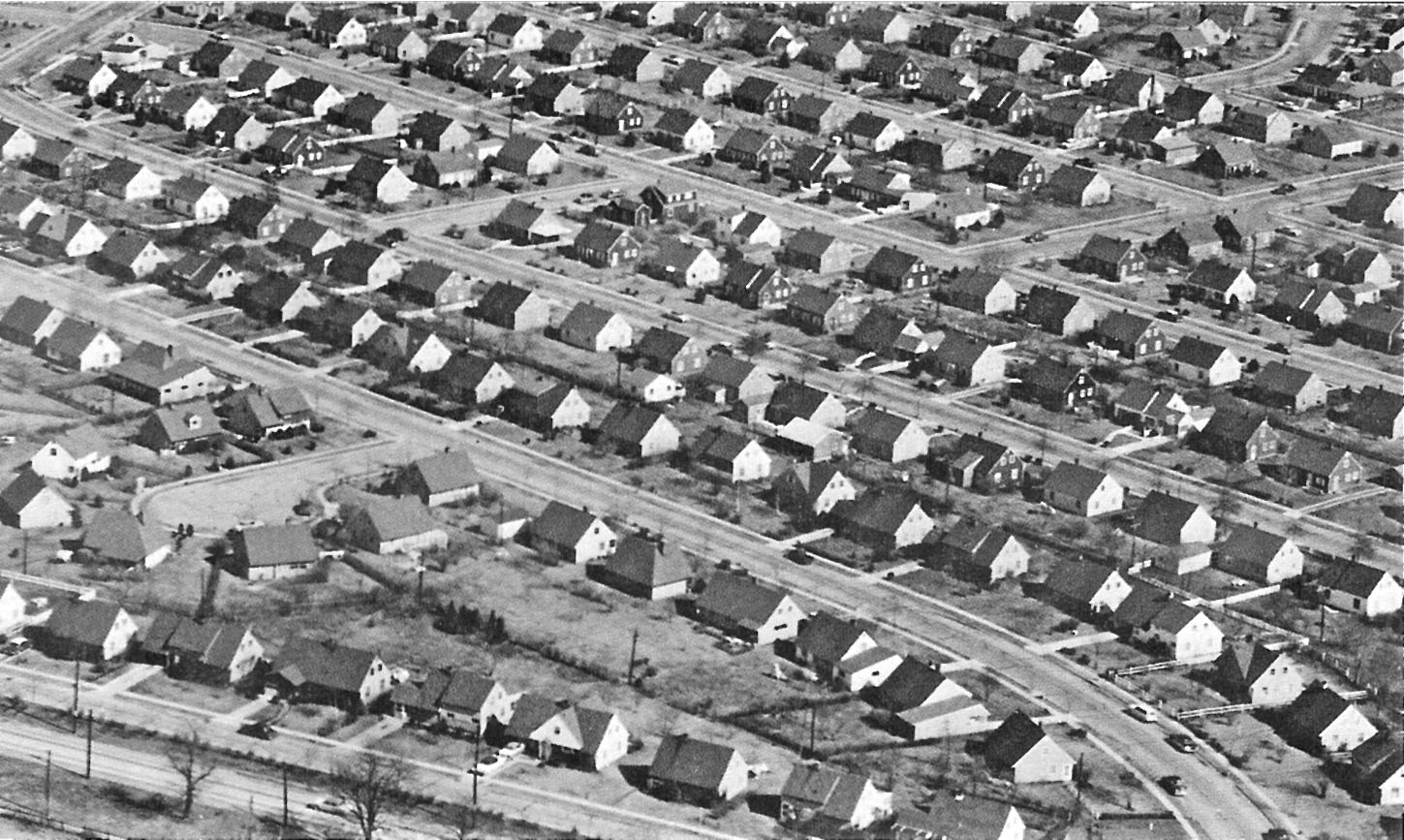
Below: 1950's box houses
https://paulmullins.wordpress.com/2013/05/07/race-and-suburban-homogeneity-the-flanner-house-homes-and-post-urban-african-america/
Subscribe to:
Posts (Atom)