Thursday, November 19, 2015

An Offer You Can't Refuge: A History of Refugees in the United States

Headlines update new stories daily with the refugee crisis in the Middle East. World Vision, a humanitarian organization, 4 million Syrians are considered refugees of the ongoing civil conflict, and are mostly situated in the bordering countries of Lebanon, Turkey, and Jordan. 700, 000 Syrian refugees have attempted to travel to countries in the European Union. While lesser known, many other refugee crises exist around the world. Amnesty International ranks the next top sources of refugees after Syria as Afghanistan, Somalia, and Sudan.

Refugees are forced out of their homes for many reasons. For example, in Syria, conflict from rebel groups fighting the former president Bashar al-Assad has forced many to flee. In Myanmar, the Council on Foreign Relations reports:
Tens of thousands of Muslim Rohingya have fled Myanmar in the past year, many of them taking to the sea in the spring of 2015 to try to reach Indonesia, Malaysia, and Thailand. 
Since independence in 1948, successive governments in Burma, renamed Myanmar in 1989, have refuted the Rohingya's historical claims and denied the group recognition as one of the country's 135 ethnic groups. The Rohingya are largely identified as illegal Bengali immigrants, despite the fact that many Rohingya have resided in Myanmar for centuries.
For a myriad of different reasons, Amnesty International continues that the world is facing 19.5 million refugees.

As a country begun by religious refugees, much like the Rohingya, fleeing from another state, America seems uniquely suited to aid similar peoples.

However, American nativism in the past has been the response to many a group seeking shelter. Bouie of Slate magazine gives a few examples:
...hundreds of thousands of Germans and Irish left their homes to escape political persecution, conflict, and famine. They followed a decade of similar but more modest immigration, stretching back to the 1830s, when the first major waves of German and Irish immigrants reached American shores. 
Despite the end of the Know-Nothings, nativism persisted in national life, as part of the deep ambivalence and fear Americans have felt towards migrants, immigrants, and refugees of various stripes. You saw it in violent form, for example, during the waves of Chinese immigration in the late 19th and early 20th centuries, when Chinese immigrants faced exclusion, discrimination, and outright pogroms from mobs of angry, resentful European Americans (some, no doubt, descended from Irish and German immigrants).
 You saw it in the late 1930s, when Americans faced Jewish refugees from Nazi Germany, and had to choose: Would we take the victims of Hitler’s anti-Semitism, or reject them? On the question of refugee children, at least, Americans said no: 67 percent opposed taking in 10,000 refugee children from Germany, according to a 1939 poll from Gallup.
Again and again, when faced with the question of refugees and immigrants, Americans are ambivalent and sometimes hostile. In 1975, for example, 62 percent said they feared Vietnamese refugees would take their jobs. Four years later, just as many said they didn’t want to admit “boat people” from Vietnam, who were fleeing the country’s repressive communist government. Americans said the same for Cuban refugees in the 1980s, Haitians in the 1990s, and most recently, the wave of refugee children from South America, which brought protests and fears of disease and infection.
The American response to the current refugee crisis has become the basis for partisan debates. Unfortunately, this issue is so divisive that individual governors and mayors have declared their views, some saying that they would never accept refugees in their jurisdictions. CBS News reports that the mayor of Roanoke, Virginia, has used rhetoric justifying an internment of Syrian refugees, similar to the internment of Japanese Americans under Roosevelt's Executive Order 9066. This internment was similarly upheld by Korematsu v. United States, a Supreme Court decision that justified Japanese-Americans being imprisoned in camps, which was later apologized for in 1983.

Looking to the past, America has clearly failed to aid refugees in times of need. Xenophobic hate has been ingrained in other examples, and fear of refugees, in light of the recent Paris attacks, has only increased. Although President Obama has created a plan to accept 10,000 refugees, Tani and Logiurato of Business Insider report that the House has just recently passed legislation requiring each potential refugee to be inspected by intelligence agencies before being admitted to the United States.

With mounting support for anti-refugee movements, the future of refugee acceptance to the United States remains unclear.

Sources:
World Vision, 11-3-2015, "What you need to know: Crisis in Syria, refugees, and the impact on children," http://www.worldvision.org/news-stories-videos/syria-war-refugee-crisis
Amnesty International, 10-12-2015, "Global Refugee Crisis – by the numbers,"  https://www.amnesty.org/en/latest/news/2015/10/global-refugee-crisis-by-the-numbers/
Eleanor Albert, 6-17-2015, "The Rohingya Migrant Crisis," Council on Foreign Relations, http://www.cfr.org/burmamyanmar/rohingya-migrant-crisis/p36651
Jamelle Bouie, 11-17-2015, "We Are a Nation of Immigrants and Refugees. And We Always Fear Who Is Coming Next.," Slate Magazine, http://www.slate.com/articles/news_and_politics/history/2015/11/america_s_long_tradition_of_fearing_refugees_the_united_states_has_always.html
CBS, 11-18-2015, "Va. mayor rejects Syrian refugees, refers to Japanese internment camps," http://www.cbsnews.com/news/roanoke-mayor-refers-to-japanese-internment-in-statement-about-refugees/
Toni Konkoly, 2-19-1942, "The Supreme Court . Law, Power & Personality . Famous Dissents . Korematsu v. United States (1944)," PBS, http://www.pbs.org/wnet/supremecourt/personality/landmark_korematsu.html
Maxwell Tani and Brett Logiurato, 11-19-2015, "Democrats just delivered a stunning blow to Obama's Syrian refugee plan," Business Insider, <span class="skimlinks-unlinked">http://www.businessinsider.com/syrian-refugee-vote-house-obama-plan-veto-2015-11</span>

Friday, November 13, 2015

William Randolph Hearst- the media of the gilded era

Hearst was born in late April, 1863 in San Francisco, California. His family was well off, and he was able to use his connections and family wealth to start a media empire. Hearst was one of the founders of "Yellow Journalism", which sensationalized news to sell more papers. Educated at Harvard, Hearst drew inspiration to become a journalist from Joseph Pulitzer, with is paper, New York World. Returning to California after completing his studies, Hearst took over his father's paper, San Francisco Examiner. Hearst hired a few of the best writers of the time, Mark Twain, Ambrose Bierce and Jack London. When he took over the paper, Hearst decided to make it profitable, so he had his writers engage in speculative and hyperbolic journalism. This gradually increased paper circulation.

With his success in San Francisco, Hearst began to look to the East coast, buying a New York paper, New York Morning Journal, which was formally owned by Pulitzer, and a year later started the Evening Journal. With so much circulation, Hearst began to accumulate political power. Hearst's papers supported the Democratic party, but not the Democratic candidate, William Jennings Bryan. Hearst stirred up pro-war sentiments to drive the American public to support the war against Spain, which allowed the Republicans to win.

After establishing news paper organizations in Chicago, Boston and Los Angeles, Hearst began his political career. He ran for president in 1900, which proved to be a short-lived endeavor. Hearst was however elected to the House of Representatives in 1902 and 1904, but he was ousted after deciding to run for the position of both New York City mayor, and New York governor. His colleagues and voters decided that Hearst was spending too little time sitting in the House, because he was managing his news corporation and two political races at the same time. Hearst lost both races and ended his political career.

Approximately one quarter of Americans were reading one of Hearst's publications by the 1920's. Hearst was making so much money that he felt it was necessary to build a baroque style castle on his deceased mother's land. He surrounded the castle with exotic animals, in fact you can still see the wild zebras if you drive past the land, and filled it with European artwork.

Hearst had some extremely controversial views which made him very unpopular. The first of his unpopular views was eugenics. Eugenics is the idea that certain afflictions must be "bred" out of society. From 1915 to 1919 a Chicago surgeon named Harry Haiselden took a hand in what he saw as evolution, or darwinism, but what the rest of the world saw as evil. Haiselden allowed or sped the deaths of at least six babies which he diagnosed as either mentally or physically disabled. Hearst damaged his reputation by publishing a serial novel that Haiselden wrote to explain his practices. Hearst continued to damage his reputation when he traveled to Berlin in 1934 to interview Hitler. This interview served to secure and legitimize Hitler's rule.

In all, Hearst promoted sensational news, eugenics and Nazis, while serving two terms in the House of Representatives and building one of the largest news companies in the US.

Sources:
Biography.com
Deathreference.com

American Imperialism; The White Man's Burden and the theory of Paternalism.

In 1899, English poet and writer, Rudyard Kipling published a poem called The White Man's Burden; the United States and the Philippines. The first stanza goes as follows:
Take up the White Man's burden, In patience to abide,
To veil the threat of terror And check the show of pride;
By open speech and simple, An hundred times made plain
To seek another's profit, And work another's gain.
The rest of the poem can be found here, on Wikipedia (yay).
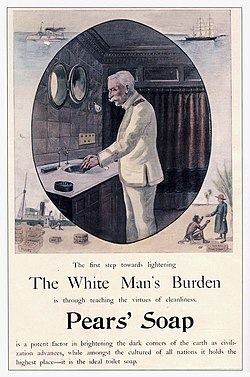
        The poem means a few things. The first is that American Imperialism was noticed abroad, and not well favored. The White Man's Burden is the concept used to justify imperialism, and was first used by Europeans colonizing Africa. The theory behind the White Man's Burden is paternalism. Paternalism is the idea that the native peoples of wherever you are colonizing cannot take care of themselves properly and therefore it is your job to go and "civilize" them. Calling imperialism a "Burden" further justifies it by making it into a noble cause, something that Americans could aspire to, and something that was in the best interest of Filipinos. 
 
The above image is an advertisement for soap. The idea is that by bringing sanitation to Africa, and thereby civilizing it. The caption reads, "the first step towards lightening The White Man's Burden is through teaching the virtues of cleanliness. Pears' Soap is a potent factor in brightening the dark corners of the earth as civilization advances, while amongst the cultured of all nations it holds the highest place -- it is the ideal toilet soap". The ad has the added connotation of cleansing the culture of uncivilized nations, with the potential to "[brighten] the dark corners of the earth", which subtly implies making the black citizens of Africa white through colonization.

The theory of paternalism was used in a slightly non-standard manner to justify American imperialism in the Philippines. It was thought that the islands ought to have their independence, but that if they were given the power of self-determination too soon, another great power in the Pacific might take control. Therefore, the United States accepted the "Burden" of governing the islands until it deemed them capable of self rule. This is a sort of paternalism of nations, that America might justify control of the Philippines by declaring itself a parent to the child, and until the child is grown, America would let it go free. And as the "parent" The US would decide when the Philippines would be ready to rule itself. While the theory of paternalism was used to justify the controlling of the Philippine islands, it was proved incorrect when America decided to release the islands after WWII. This proves that the US did not truly care about the development of the island nation (it also chose not to extend the US constitution overseas), but decided that it was too unprofitable to defend.

Sources:
Thank you wikipedia:

Thursday, November 12, 2015

Teddy Roosevelt and Progressive Reform

The rise of industrial capitalism in the United States led to the growth of progressivism as well as several economic and social crises. There was repeated armed conflict between workers, governments, and private militia, sometimes in the form of labor union strikes. These clashes were often violent and sometimes were on scale so large that federal Army troops were required to quell the uprisings. In fact, in what became known as Coxey's Army, hundreds of unemployed men marched on Washington D.C. in 1894 to protest the poor economic conditions that had followed the Panic of 1893 and to convince the government to create jobs and make other public work improvements (Britannica).

Coxey's Army


The gap between the wealthy capitalists and the working class of society was ever-widening, prompting muckraking journalists to write sensationalist pieces that exposed the exploitations and corruption of government officials. From this broken system, which many thought violated the underlying principles that the country was originally founded on, emerged progressivism, a mindset that included three main areas of reform: controlling corporate power, conserving natural resources to lessen the detrimental effects of industrialization, and protecting consumers by making government less corrupt and more democratic.

To achieve these goals, the progressives attempted not to completely get rid of big business, but to regulate it and lessen the impact of capitalism for the general good of the public. This focus on benefiting individuals was stated aptly by Teddy Roosevelt when he said that the government should be the "steward of the public welfare." (Swinth) Eventually, the progressives agreed not to dissolve big business, and instead to regulate it through the power of the state and lessen its influence on political and economic aspects of society.

Roosevelt, Theodore [Credit: Library of Congress, Washington, D.C. (digital file number cph 3a53299)]
Teddy Roosevelt, the champion of progressivism and the policy of regulation.

As a champion of progressivism, Roosevelt used his position as the president as a "bully pulpit" to increase awareness of the issues surrounding the time. He saw the consolidation of power in the hands of a few wealthy industrialists as potentially dangerous not only to fair markets but to democracy itself. As such, he used the famous Sherman Anti-Trust Act to challenge certain businesses that held monopolies, such as a railroad trust called the Northern Securities Company. His policy of regulating stemmed from his belief in the inevitability of big business developing naturally. This very policy was his "square deal" to the people, the same idea that would be the center of his progressive Bull Moose Party in the election of 1912. It was very much a compromise, a way to monitor the coexistence of business and labor.

Progressivism was evident in Roosevelt's policies in other ways, too. He supported workers' rights to organize, the eight-hour workdays, and an income tax on the wealthy. He was also very passionate about conservation, as seen in his creation and designation of several new national parks and monuments, not to mention numerous wildlife preserves. Roosevelt's moderate policies that balanced reform and regulation led the nation through economic crises and prepared it for modern industrial society.


Monday, November 9, 2015

Yellow Journalism: Media's role in War


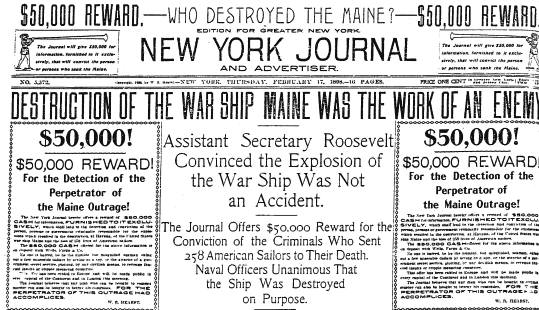
Oversea expansion was no doubt influenced by the media, more specifically yellow journalism. One of the first few wars involving large scale media was the Spanish American War. Media was a means to boost the nation's morale and unite the nation against a common enemy for a common cause. One of the styles of journalism most prominent at the time was "yellow journalism" led by William Randolph Hearst and Joseph Pulitzer.  The term came from a character dressed in yellow that was depicted on a New York World comic, "Hogan's Alley", who adapted the name "the yellow kid". To compete with Pulitzer's New York World, Hearst's New York Journal imitated the sensationalist style of Pulitzer and even hired the same cartoonist that had created "Hogan's Alley". This style of journalism was romantic, melodramatic, and exaggerated many of the events that occurred leading up to the Spanish American War.


In the Cuban Revolt of 1895, American journalists portrayed the Spanish as harsh oppressors, shutting down Cuba's desire for independence. Hearst and Pulitzer, both being pro-imperialist used yellow journalism to elicit emotional reactions towards the Cuban revolt and to evoke sympathy among the American public. Much of the events reported in yellow journalism was far from the truth, twisted in every aspect in attempt to gain sympathy for Cubans and hatred for the Spanish. Yellow journals like New York Journal and New York World published stories of female prisoners, starving children and women, executions, and heroic rebels fighting for their cause, much like Americans once fought for theirs. More importantly, Hearst's hit newspaper was published, the sink of the battleship Maine in Cuba. Without evidence, Hearst blamed the Spanish for this accident and caused the American public opinion to demand intervention in this cause. Yellow journalism marks the beginning of media and press's influence over the public morale in America and how these public opinions spark intervention through war.

Source:
http://www.pbs.org/crucible/frames/_journalism.html

The Vehicle of Oppression

It is said that capitalism is the vehicle of oppression. If this is true, then the train must be the vehicle of the vehicle of oppression.

The Great Railroad Strike of 1877 was an outlet of violence, caused by the horrible conditions the men running the trains worked in. Railroad work in 19th century America was a dangerous affair, and considerably more so than that of their British contemporaries. Fatality rates among American railworkers were twice those of British ones, a consequence of a preponderance of freight traffic rather than passenger.(1) Especially in the midsts of economic turmoil, the dangers and low wages of a railroad job were bound to produce discontent.
Workers were not the only ones endangered by trains. Train wrecks were uncomfortably common occurrences, and often made cover stories. For example, and 1876 bridge collapse in Ohio took the lives of 86 passengers.(2) All these mounting deaths would eventually force the federal government to create regulatory legislation. Combined with new technologies like better brakes and couplers, policies like the 1893 Safety Appliance Act would come to drastically decrease fatalities on the rail.(1)

Part of the reason workers were so expendable was the tendency of railroads to hire from immigrants. Among the first such workers were masses of Irish immigrants who served as cheap sources of unskilled labor.(3) Since most arrived in poverty and faced nativist discrimination, they could not choose the sort of jobs they worked. Direct dangers of the railroad were not the only causes of death: poor nutrition and medicine took many worker lives as well. Fear of diseases like cholera compounded by anti-Catholic sentiments often prevented Irish workers from getting the treatment they needed. Eventually, the railroads would serve as a way to move up to a more semiskilled job; workers moving up to better jobs would recruit newly-arrived immigrants to replace them in their old jobs. Eventually, this part of the workforce would come to be Americanized.
On the other side of the coast, railroad work was famously dominated by the Chinese. During work on the Transcontinental Railroad, Leland Stanford told Congress: "A large majority of the white laboring class... find more profitable and congenial employment in mining and agricultural pursuits, than in railroad work."(4) For this reason, the Chinese were more easily hired. Eventually, up to 15,000 Chinese were working on the rails. Wages of Chinese laborers would eventually rise to match those of their white counterparts, but still worked longer hours and had to pay for their own lodging and tools. When Chinese workers did strike in 1867, the nonviolent affair was ended when their supplies were cut off for eight days. For their work on the railroad, the Chinese became subjects of typically discriminatory legislation that segregated schools, prevented immigrants from appearing as witness in court, or becoming naturalized citizens.(5) Such is the way of racism in America.

Yes, this post was made purely for the sake of an elaborate pun. Anything educational about this post is an accident.

Sources:
(1) https://eh.net/encyclopedia/history-of-workplace-safety-in-the-united-states-1880-1970-2/
(2) http://www.wcrscorp.com/resources/frasafety.pdf
(3) https://hsp.org/sites/default/files/studentreadingimmigrantlaborontherailroads_revised.pdf
(4) http://web.stanford.edu/group/chineserailroad/cgi-bin/wordpress/faqs/
(5) http://www.class.uh.edu/gl/china1.htm

Saturday, November 7, 2015

The United States Navy

Ever since the Civil War, the United States navy had stayed largely dormant as American foreign policy drew inwards and the focus turned to the frontier and economic industrialization. As a result of this, the United States Navy became obsolete and its operations poorly organized due to lack of experience. With its limited role following the Civil War, the United States Navy fell decrepit and had few foreign uses, such as in Korea during the Korean Intervention.

In the 1880's, the government began to expand the role and funding for the navy. It linked the powerful American steel corporations with the new naval shipyards to establish a mutually beneficial relationship that would bring profit to the steelyards and a better navy to the United States. At the end of the 1880's the USS Charleston and the USS Baltimore were designed and completed. But as a testament to how lacking the United States was in naval power, the company that created these steel cruisers, the first of their kind for the United States, was British. In the early 1890's, the USS Texas and the USS Maine are also laid down and sent out. In the early 1900's the USS Connecticut was laid down as the first of six battleships that would later be used for President Roosevelt's Great White Fleet. The USS Holland was the first commissioned naval submarine in 1900. All of this advancement in the United States Navy culminated in the creation of the USS South Carolina in 1910 as the first American dreadnought, the flagship of the new century.

At the same time that the United States began to churn out their ships, other nations around the world did the same. There is a connection between this new naval arms race and Alfred Thayer Mahan's book, The Influence of Sea Power Upon History which discussed the importance of maintaining a strong navy to control the seas in time of war. Commerce raiding and secondary tasks were nothing compared to the dominance of naval task groups to win the dominance of the seas. Mahan was massively influential in the naval doctrine of the United States as well as playing a significant role in the development of the Japanese and German naval doctrines. What The Art of War did for strategy and what Vom Kriege (Clausewitz) did for political-military relations, The Influence of Sea Power Upon History did to naval doctrine.

With this new navy, President Roosevelt sent it on a world wide tour in 1907 that would last a little more than a year. The newest cruisers and battleships would be sent around the world as an offhand show of strength to the Germans, British, and Japanese. As a continuing part of his Big Stick policy, Roosevelt showed the world that their threats and policies were to be respected and honored because we had the navy, the big stick, to back it up. We showed that we could sent a fleet around the world to any place, something that had not been done on such a scale with modern warships. Roosevelt showed the rest of the world that the United States could maintain its two ocean navy and be strong in both. It was the ultimate show of naval arms in the early 20th century. As other nations begin to do the same, this massive naval arms race will eventually lead to the Washington Naval Conference of 1921 to limit the largest nations' navies.
Speak softly and carry a big stick; you will go far - President Theodore Roosevelt
And yet a mere century after the rapid build-up of the United States Navy and just 30 years after Regan's "600 ship navy", the United States naval build-up is far slower than it ever has been in the last 100 years. But this is simply because the last century has seen the complete dominance of the United States on the high seas (although recently the Chinese have begun to challenge this just as the Soviets did during the Cold War). The United States Navy consists of 10 active aircraft carriers, 8 more than the next country, and dozens of guided missile cruisers, destroyers, and submarines. The United States Marines and Navy SEALS are the most capable special forces around the world and our nuclear subs freely travel the waves. The lasting influence of A.T. Mahan, the initial US Navy build-up, and both World Wars have brought the United States to the naval powerhouse that it is today. Without the policies of the US government under McKinley and Roosevelt, it could be very possible that the Germans, Russians, or Japanese would be the masters of the seas today and not the United States Navy.

Works Cited
Hacker, Barton C., and Margaret Vining. "The Steel Navy and the Naval Industrial Complex." American Military Technology: The Life Story of a Technology. Westport, CT: Greenwood, 2006. 53-54.Google Books. Web. 7 Nov. 2015.
Here's the Entire U.S. Navy Fleet in One Chart. Digital image. Popular Mechanics. N.p., 30 Apr. 2015. Web. 08 Nov. 2015.
Holmes, James R. "Japanese Maritime Thought: If Not Mahan, Who?" Naval War College Review. By Toshi Yoshihara. Vol. 59. Newport: United States Naval War College, n.d. 24-26. United States Naval War College. Naval War College, Summer 2006. Web. 7 Nov. 2015.
"Mahan & The Influence of Sea Power Upon History." Global Security. Global Security Institute, n.d. Web. 08 Nov. 2015.
"A POWERFUL PRESENCE THROUGH THE YEARS." America's Navy. Navy Recruiting Command, n.d. Web. 08 Nov. 2015.
"U.S. Navy Ship List, 1890." BLUEJACKET.COM. N.p., n.d. Web. 08 Nov. 2015.